Types of Jhumkas: 8 Styles and How to Tell Them Apart
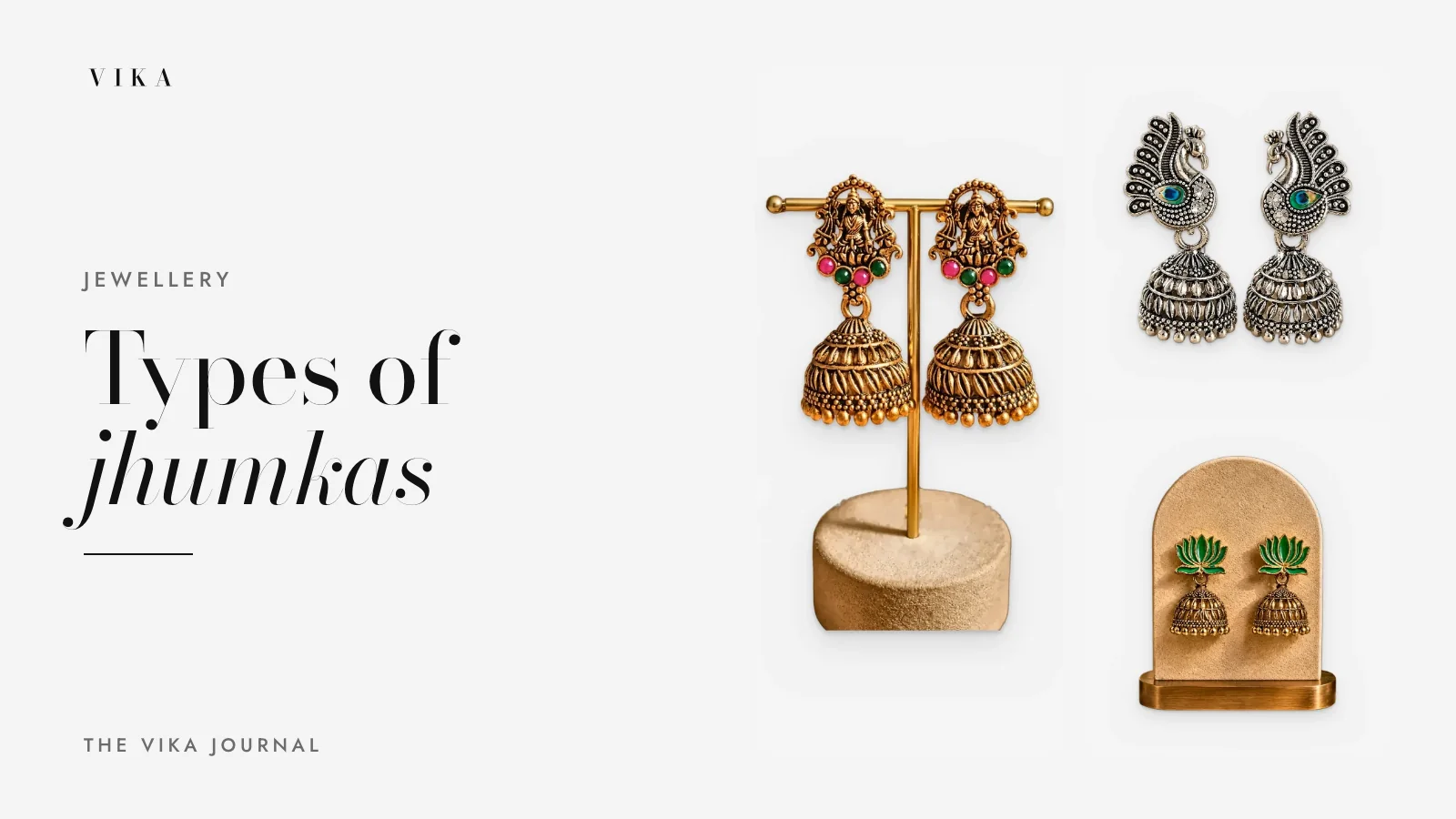
In this guide
The main types of jhumkas are temple, oxidised, enamel, peacock, stone-set, pearl-drop, mini and chandbali-style jhumkas. All of them share one shape: a hollow bell that hangs from the ear. What changes is the finish, the motif and the size, and those three decide whether a pair suits a college day, a festival or a wedding.
This guide explains each type in plain words, shows examples from our own shop, and ends with a simple way to choose.
What makes an earring a jhumka
A jhumka is a bell-shaped earring. The Victoria and Albert Museum in London, which holds jhumkas in its jewellery collection, describes one pair as having a bell-shaped hollow dome (jhumka) hanging from a silver loop. That bell is the defining part. Above it there is usually a stud or a decorative top that sits on the earlobe, and below it a fringe of beads, pearls or small bells.
You will also hear "jhumki", which most people use for the same earring, often a smaller one.

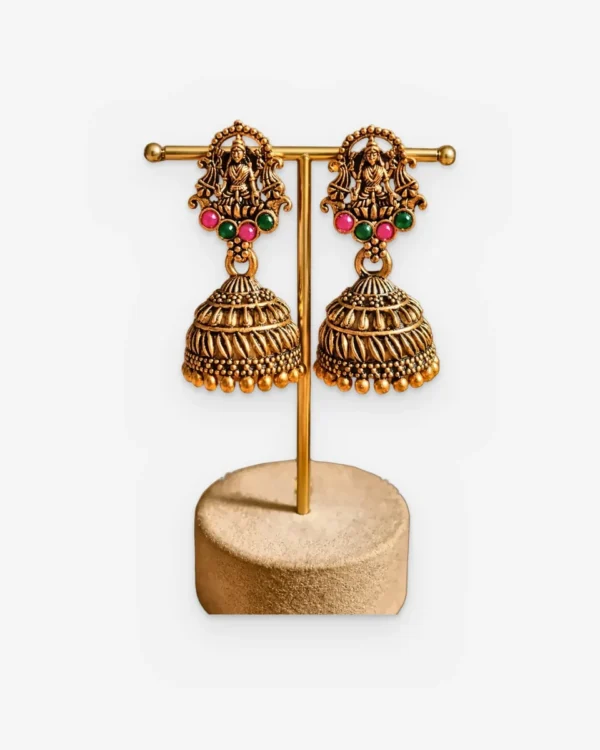
1. Temple jhumkas
Temple jhumkas carry religious motifs, such as a deity, a temple tower or a lotus, usually in an antique gold finish. They look rich and traditional, and they are the natural pair for silk sarees, pattu pavadai and temple visits.
Temple jhumka
2. Oxidised jhumkas
Oxidised jhumkas have a deliberately darkened silver-tone finish, so the pattern stands out in grey and black. They are the everyday favourite: they suit cotton kurtis, handloom sarees and even denim. We explain what the finish is in what oxidised jewellery means, and how to keep it dark in how to clean oxidised jewellery.
Oxidised jhumka

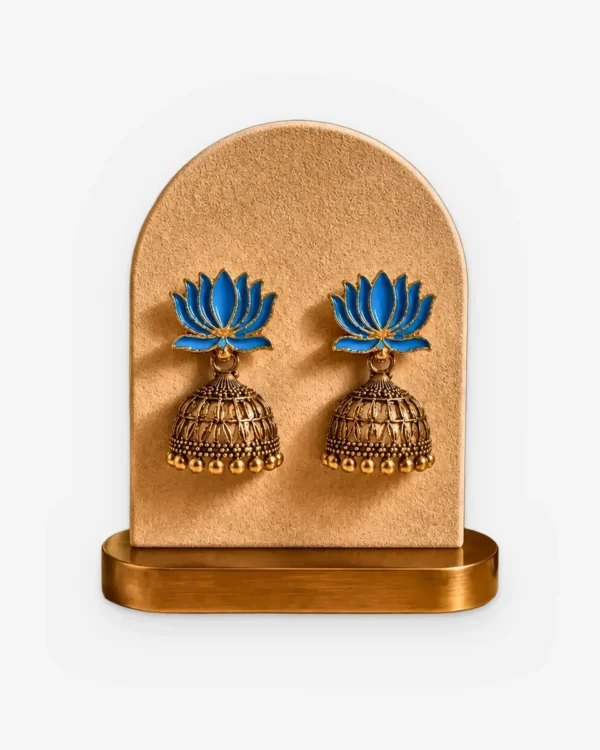
3. Enamel jhumkas
Enamel jhumkas have coloured enamel set into the metal, often as flowers or leaves. The colour makes them easy to match: pick a shade from your outfit, or a contrast to it. A red or green pair with a plain saree is a classic combination.
Enamel jhumkas


4. Peacock jhumkas
The peacock is one of the most loved motifs in Indian jewellery, and it appears on jhumkas in every finish, from oxidised to antique gold. Peacock designs tend to be detailed, so they look best when the rest of your jewellery is simple.
Peacock jhumka

5. Stone-set and crystal jhumkas
These have coloured stones or crystals set into the top, the bell or both. They catch the light, so they suit evening functions and celebrations. Choose a stone colour that repeats something in your outfit, like the border of a saree.
Crystal jhumka

6. Pearl-drop jhumkas
Many jhumkas have a fringe of small pearls or beads around the rim of the bell. Pearl fringes soften the look and move as you walk. Some jhumkas are almost entirely pearl, which makes them lighter on the ear.
7. Mini jhumkas
Small jhumkas, often called jhumkis, are the everyday version. They are light enough for long days, sit neatly under a dupatta or a helmet, and work for office and college. If you are buying your first pair, a mini jhumka is the easiest to wear often.
8. Chandbali-style jhumkas
A chandbali is a crescent-moon shaped earring. Some designs combine the two, with a crescent on top and a bell hanging below. They are larger and more formal, and best kept for weddings and festivals.
How to choose: occasion, outfit and weight
| Occasion | Types that suit it | Size |
|---|---|---|
| College, office, daily | Oxidised, mini, simple enamel | Small |
| Temple visit, pooja | Temple, antique gold enamel | Small to medium |
| Festival, family function | Enamel, peacock, stone-set | Medium |
| Wedding | Temple, stone-set, chandbali-style | Medium to large |
Two practical points matter as much as looks:
- Weight. A large jhumka pulls on the earlobe over a long day. If your ears get sore, choose a smaller pair, or wear the big pair for the function only.
- Sensitive ears. The NHS lists metals such as nickel or cobalt in jewellery among the causes of contact dermatitis, an itchy skin reaction. If earrings make your earlobes itch or turn red, take them off and keep them for short wear.
For outfit pairing in detail, read how to style jhumkas, and for every other earring shape, see types of earrings.
Browse all our jhumkas.
Questions people ask
What is the difference between a jhumka and a jhumki?
Most people use the two words for the same bell-shaped earring. Jhumki is often used for smaller, lighter pairs.
Which type of jhumka is best for daily wear?
Small oxidised or simple enamel jhumkas. They are light, go with cotton and casual outfits, and are less likely to make your ears sore.
Which jhumka suits a silk saree?
Temple and antique gold jhumkas are the traditional choice for silk. Enamel jhumkas in a colour from the saree border also work well.
Are big jhumkas heavy?
Large jhumkas can be heavy over a full day. If yours pull on your ears, wear them only for the event, or choose a lighter, smaller pair.
Sources
- Victoria and Albert Museum: Pair of jhumka earrings, object O1350613, read 14 November 2026.
- NHS: Contact dermatitis: causes, read 14 November 2026.


