Are Claw Clips Bad for Your Hair? What Dermatologists Say

In this guide
Are claw clips bad for hair? No, not when you wear them loosely. A claw clip holds hair without winding anything tightly around it, which makes it one of the gentler ways to put hair up. The harm people worry about comes from pulling, and that depends on how tight the style is, not on which accessory you use.
Here is what dermatologists say causes damage, how to tell if your own style is too tight, and the habits that keep a daily claw clip safe.
What actually damages hair: pulling
The American Academy of Dermatology (AAD) explains that hairstyles which constantly pull on the hair can, over time, lead to hair loss. The medical name is traction alopecia, and the hairline is one of the first places it shows.
The AAD's list of styles that can cause it, when they are too tight, includes buns, ponytails and up-dos that are tightly pulled. It does not name any accessory. A tight bun is a tight bun, whether a rubber band, a pin or a claw clip is holding it.
The same organisation's advice on everyday habits is short. For hair pulled back tightly, it suggests you wear hair loosely pulled back, use covered rubber bands made especially for styling hair, or try a different hairstyle that does not pull.
Claw clip or hair tie: which is gentler?
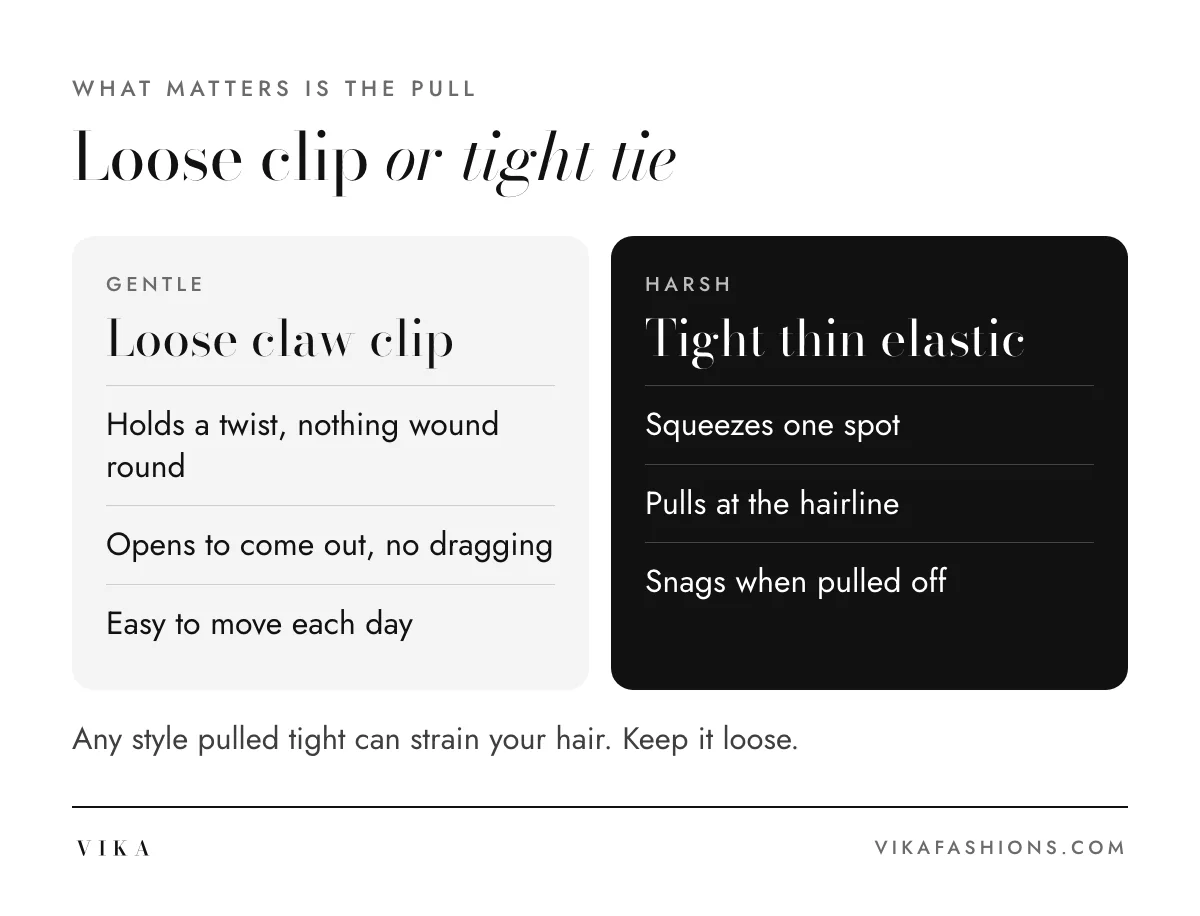
A claw clip has two things going for it. It does not squeeze a ring around the same strands every day, and it comes off by opening, not by dragging along the hair. A thin, tight elastic does both of those things.
That does not make every clip harmless or every tie harmful. A soft fabric scrunchie worn loosely is gentle too. And a claw clip fixed over a twist that has been cranked tight will pull on your hairline as much as any ponytail. We compare the fabric options in our guide to satin scrunchies.
Warning signs your style is too tight
The AAD says to change your hairstyle straight away if you notice any of these:
- Pain from tightly pulled hair.
- Stinging on your scalp.
- Crusts on your scalp.
- Tenting, where sections of scalp are pulled up like a tent.
Day to day, the practical test is simpler. If you feel relief when you take your clip out in the evening, it was too tight.
Seven habits that keep a daily claw clip safe
- Keep the twist loose at the roots. The firmness should be in the twisted length, not at your hairline.
- Move it around. Clip high one day, low the next, half-up the day after, so the same strands are not held every day.
- Do not sleep in it. A hard clip between your head and the pillow presses and pulls. Use a soft scrunchie at night, or leave your hair loose.
- Go easy on wet hair. The AAD notes that hair is delicate when it is wet. Let it dry a little before you twist and clip it.
- Use the right size. A clip that is too small for your hair needs a tighter twist to hold. See how to choose a claw clip for thick hair.
- Check the teeth. Run a finger along them. Rough edges or a cracked tooth can snag strands. Replace a damaged clip.
- Open it fully to remove it. Never pull a closed clip out of your hair.
Claw clips from our shop

When to see a doctor
A claw clip will not cause sudden hair fall. If you are losing more hair than usual, or see thinning at your hairline or parting, the cause may have nothing to do with styling. The AAD points out that hair loss has many causes. A dermatologist can tell you what is going on, and it is worth going early.
The short answer
Wear it loose, move it around and take it out at night. Used that way, a claw clip is a kind choice for everyday hair. For styles that stay comfortable, try our six claw clip hairstyles, or browse the full range of hair claw clips.
Questions people ask
Can claw clips cause hair loss?
Not by themselves. Hair loss from styling comes from styles that pull tightly on the hair again and again. A loosely worn claw clip does not pull that way.
Is it okay to wear a claw clip every day?
Yes, if the style is loose and you change the position of the clip from day to day. Take it out before you sleep.
Are claw clips better for your hair than hair ties?
They are gentler than a thin, tight elastic, because they do not squeeze a ring around the hair or drag when removed. A soft, loosely worn scrunchie is also gentle.
Can I sleep with a claw clip in my hair?
It is better not to. The clip presses against your head and pulls as you move. A loose braid or a soft scrunchie is more comfortable.
Sources
- American Academy of Dermatology: Hairstyles that pull can lead to hair loss, read 14 November 2026.
- American Academy of Dermatology: Hair styling habits that can damage your hair and Tips for healthy hair, read 14 November 2026.